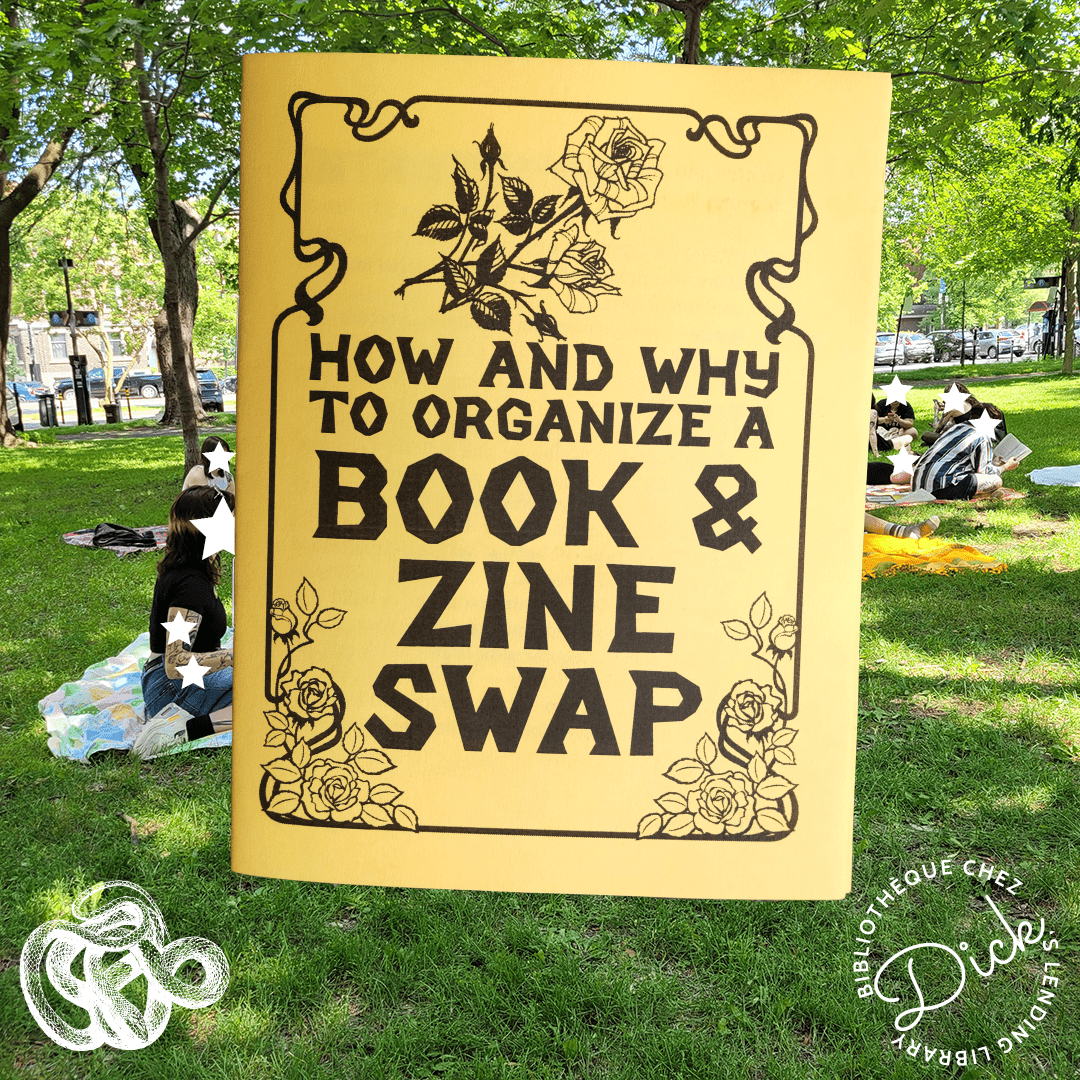
Hello! I’ve been thinking about zine fairs (and book fairs, small press fairs, and other places where people stand behind a table and sell you little booklets). I’ve tabled at, I think, about 10 events this year, with a couple more coming up before the year is through.
Tabling at zine fairs brings in a substantial amount of Sheer Spite’s income, and it’s also a huge amount of work. Physically, I am lugging huge bags and boxes of zines all over the place, financially, I am committing to travel and table fees while never really knowing if I’ll make back a cent, emotionally and mentally, I am having hundreds of conversations, many of them about the often-intimate topics covered by zines I write or carry, while also doing math on the spot. The combination is pretty intense.
I have organized a zine fair before, and I can testify it is an enormous amount of work. I am profoundly grateful for everyone who organizes a zine fair of any kind. It is a big investment into community cohesion, solidarity, the livelihoods of small artists, and the well-being of arts scenes, all of which are extremely vital, but you as a zine fair organizer definitely personally do heroic amounts of work that are not compensated in anything so concrete as money.
The view from behind the table
Anyways, while every zine fair is a labour of love and a vital and precious thing, as someone who tables at a lot of zine fairs, I wanted to express gratitude about some things that zine fairs do that make them especially wonderful to table at:
1. Consider accessibility in a serious way
Event accessibility is a whole galaxy of things to consider, including but in no way limited to considerations like these:
- Can people even get in the damn door? And can everyone get in in an equally dignified, pleasant, convenient way? I feel like shit when I table at an event and realize that I can’t invite pals who use wheelchairs to stop by and visit me, or if they’ll have to roll all the way around the building to some freight entrance somewhere.
- Can someone using a wheelchair easily access the washrooms? Are the washrooms gendered or are all of us transes holding our piss until it’s an emergency in case anyone decides to be weird today? No word of a fucking lie, I once tabled at a queer zine fair that had a venue security guard posted by the washrooms who yelled at me for going into the “wrong” one.
- What’s the mask situation? I personally wear an N95 whenever I’m in an indoor public space, even though I’m usually the only one doing so. I have plenty of disabled friends who I know just won’t come to an event where at least most people aren’t masked most of the time. Paper Jam in Toronto is one zine fair that required masks, and Zine Dream, also in Toronto put a good-quality mask out for each of the tablers, and many people wore them.
- How about air filtration? Are there windows you can keep open? Can you borrow a bunch of HEPA filters from somewhere? It is kind of grim that we just accept that “con crud” is a thing, and honestly I really fear getting sick or getting anyone else sick at zine fairs, since if you have to miss other events due to illness, you can miss out on big chunks of income. And also, obviously, this risk isn’t shouldered equally by everyone, people who are immunocompromised or otherwise already disabled will pay a higher price for getting sick at an event. If you’re not mitigating illness transmission at your event, you’re missing out on having a bunch of cool disabled people as tablers and as attendees, which is a bad outcome you should want to avoid, because disabled people make a lot of great art!
- Do you have a scent policy? Can you replace the soap in the washrooms with a scent-free one?
- A Deaf zinester friend also mentioned to me once how much of an access barrier crowdedness is for people who sign: it’s physically hard to have a conversation when you’re squished in somewhere like sardines!
This is just a couple of things off the top of my head, for more, please see the Accessibility Checklist for Comic Art & Zine Fairs, from the Comics Cultural Impact Collective (UK), and Organising COVID Safer Zine Fests, from Zine Jam, both of which are also found on the resources page.
2. Be small and specific
One zine event that holds a special place in my heart is the
Kagat Zine Fair, an event for and by Filipinx/a/o zinesters, makers, and artists. I’ve attended their 2024 and 2025 events and both made me feel deeply warm-hearted about zines and Montreal and life in general. The event is organized by
Centre Kapwa, “a non-profit organization decolonizing Filipinx-Canadian diaspora mental health and wellness through Art, Movement, and Conversations.” The fair is small, with about 20-some tables, but with great talks and workshops, and a friendly, welcoming, vibe that made me want to stay and hang out and chat, rather than just squeeze my way through a crowd to buy some stuff.
I also love all the specifically queer and trans zine fairs I’ve tabled at, and would love to someday visit New York’s amazing-looking
Black Zine Fair, and to table at the
Midwest Perzine Fest. I think there is really something to be said for an event with a focus on a specific community or form, and an ability to respond to community needs in a thoughtful, specific way, as well as for events that are just on a more human scale.
L’Incroyable Salon du zine, also in Montreal, is another really lovely small zine event, also with about 20 tablers. Their events begin before the sale opens to the public, with all the tablers gathering in the centre of the room for a conversation. I was really nervous the time I tabled at this event because I think I was the only person selling work primarily in English, but I felt so welcomed and made some lovely new friends, and was able to connect into some extremely cool zine stuff happening right in my neighbourhood.
3. Or, exist for decades and draw huge crowds
The absolute opposite of a small, intimate zine fair is Montreal’s
Expozine, which draws around 15,000 attendees over two days each year. It can do this because it has existed since 2002. This long-term commitment and consistency means that you don’t have to be a zine weirdo (affectionate) to know about Expozine; it draws in a huge crowd of people who are interested in arts or books more broadly, and that means tablers can often make a whole bunch of money, which is huge. I am really deeply in awe of the work that goes into putting on Expozine, and its organizers’ commitment to keeping it going.
My little corner of Expozine 2024
4. Let people know early whether they got in
This is much more common for big fairs that draw an international audience, but having a timeline further in advance is nice even for locals. When I apply for an event, it’s blocked off in my calendar until I hear back one way or another, which prevents me from making any other plans. I also make decisions about print runs based on what events I have coming up. And since I can only do one, or MAYBE two events a month without Serious Consequences to my physical and mental health, being able to plan ahead hugely helps me budget my energy.
(Also, please let people know if they didn’t get in! It’s a bummer when you get that “you weren’t accepted” email but it’s so much worse to just realize you weren’t chosen when you see the tabler list go up.)
For an example of a longer timeline:
- Miss Read, a truly wonderful fair in Berlin, had their table applications open from January 16 to February 15 of this year, with rolling acceptances throughout and after that period. I applied the day applications opened because I reeeeeally wanted to go.
- I got my acceptance March 3, which gave me lots of time (over 3 months) to plan a trip to Europe and apply to other events taking place in the region around that time
- On May 15, I got an email with all the logistical details for the event. The earlier and more clearly you can communicate details like load-in and setup times, accessibility information, and other information about the event, the better! I am far from the only zine person who is an anxious nerd who values planning ahead, and I also want to be able to promote the event and tell people about it!
- The event took place June 13-15, and it was great! I was so happy to be able to attend some international fairs, which I couldn’t have done if they didn’t have a lot of lead time to allow me to plan, and to apply for the grant that paid for the trip. I wrote about my Euro zine tour here.
5. Take care of your tablers
One zine fair that made me feel wonderfully cared for as a tabler was
Artspace Peterborough‘s Book + Zine Fair, which I tabled at this spring. While it was a smaller event in a smaller city, it was extemely well-organized, and planned to coincide with the city’s Art Crawl, so it was very well-attended.
They also had a green room in the back for tablers, which was stocked with tea, coffee, and snacks, as well as being just a quiet place to sit and rest and chat with fellow tablers. The event also had lots of volunteers, and one of the things they did was circulate amongst the tablers to make sure we knew about the green room, and to offer, repeatedly, to watch our tables so that we could take a break. Just typing that out made me tear up at the memory: I generally table alone, and as mentioned above, wearing a mask. The result of this is that usually by the end of a zine fair I haven’t eaten all day, am dehydrated, and have not breathed any fresh air or stretched or remembered I exist as a person, in many hours.
Behind my table at Artspace PTBO, with tea and a cookie
What Artspace did was kind, and it was also an accessibility measure. Many (most???) people can’t just stand and talk all day without a break. When you make it possible, or even easy, to take a break, you open tabling up to people who aren’t World Class Endurance Tabling Machines, which is, again, most of us.
Anyways, these are just a few examples of things I believe make for a zine fair that is pleasant to table at. Got something to add to this list? Email me at lee@sheerspite.ca.
But again, I cannot stress enough that anyone who organizes any kind of zine fair ever has my deepest respect and gratitude.